The Numbers
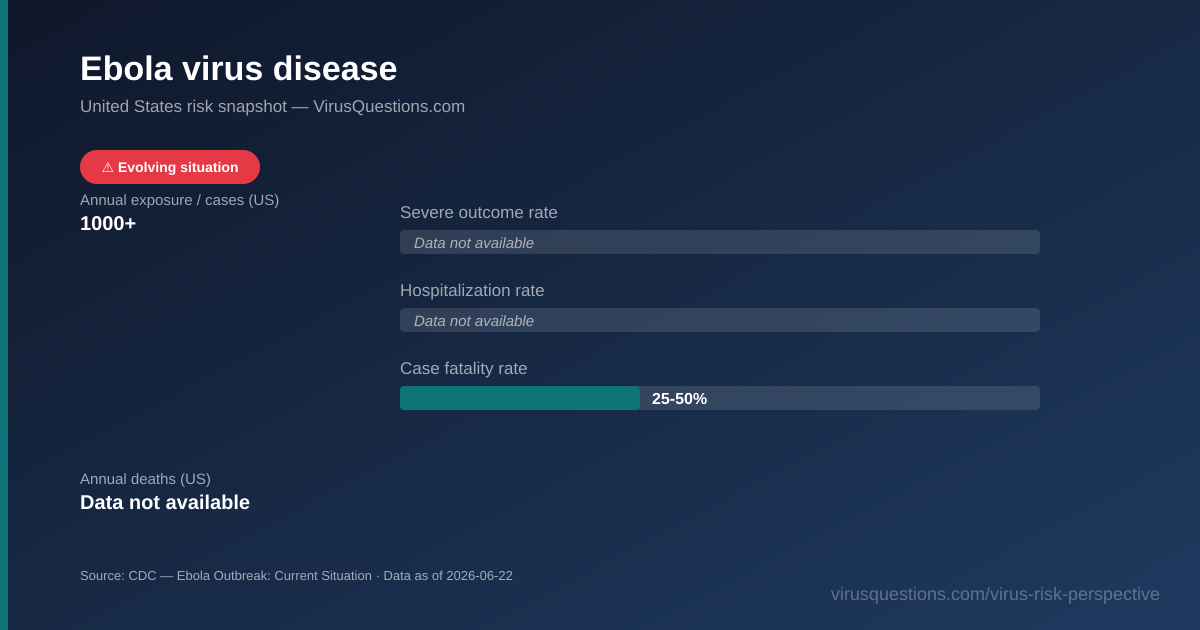
Evolving situation: Active WHO-declared PHEIC outbreak (Bundibugyo virus) centered in DRC, with a smaller, now-contained arm in Uganda's capital, Kampala. It is the second-largest Ebola outbreak ever recorded. Zero cases reported on U.S. soil; CDC assesses the risk to the general U.S. public as low (risk page updated September 8, 2026) and the likelihood of spread to the United States as very low.
- Confirmed cases (DRC, 2026 outbreak): 7,200
- Confirmed deaths (DRC): 3,475
- Case fatality rate (2026 outbreak, crude): ~48%
- Case fatality rate (Bundibugyo, two prior outbreaks): 25–55% depending on source (CDC: 32% in Uganda 2007 and 55% in DRC 2012; pooled estimate 32.8%, 95% CI 25.8–40.2)
Source: CDC — Ebola Outbreak: Current Situation · Data as of 2026-09-12 (page dated September 14, 2026). Historical Bundibugyo rates from CDC's History of Ebola Outbreaks (reviewed May 29, 2026) and Izudi et al. 2024; the outbreak history page lays out why sources differ. Updated September 15, 2026 — previous figure on this page: 4,053 confirmed cases and 1,850 deaths as of August 5, 2026.
Every published figure, and where it came from
These are the figures Ebola is actually reported with, each shown beside the source that published it and the date it was current. They are read from a single dataset shared across this network, so a correction made once reaches every page that cites it.
No United States figures are published for Ebola, and that absence is itself the finding rather than a gap in this page. Not present in the US — the only US cases ever (2014) were travel-associated, and risk to the US public is very low. Where a virus is not established in the US, CDC has no domestic case series to report — so the honest US position is an empty one, not a zero. The figures that do exist are global, and are below.
Ebola is not endemic in the United States and has no annual US case count — the only US cases on record were a handful of imported/travel-associated infections in 2014. The active outbreak CDC is tracking (7,200 confirmed cases in DRC as of September 12, 2026) is abroad, so US annual exposure/cases is UNAVAILABLE rather than a domestic figure; see Global (WHO) for the disease's case-fatality range. The Bundibugyo species has two prior outbreaks (Uganda 2007, DRC 2012); CDC's outbreak history page (reviewed May 29, 2026) gives 32% and 55%, WHO gives 30% and 50%, and the pooled estimate is 32.8% (95% CI 25.8–40.2) — a species characteristic rather than a US rate, and the 2026 outbreak's crude CFR (~48%) sits above it.
Beyond the United States
WHO puts the average Ebola case fatality rate at about 50%, ranging 25–90% across past outbreaks. Ebola cases and deaths are outbreak-driven rather than an annual global figure, so they are left UNAVAILABLE. Fact sheet re-read 2026-09-15: dated 24 April 2025 (the date now carried here) and unchanged — still "around 50%", 25–90% across outbreaks; the current Bundibugyo outbreak's crude figure is on the US-scope record.
Why Ebola's Case-Fatality Rate Is So High
Across all species, WHO puts the average Ebola case-fatality rate near 50%, ranging from about 25% to 90% in past outbreaks. Several factors drive that lethality: Ebola disease progresses rapidly to a "wet" phase of severe fluid loss and, in some patients, organ failure and bleeding; there is no approved vaccine or treatment for Bundibugyo virus (the licensed Ebola countermeasures target the Zaire species); and outbreaks tend to occur in low-resource, sometimes conflict-affected settings where early, intensive supportive care is hardest to deliver. Early supportive treatment measurably improves survival — which is why speed of detection and access to care matter so much.
Case counts and mortality data on this page are sourced directly from CDC and WHO as cited above. This is statistical and educational information, not medical advice or a risk assessment for any individual. Figures for this ongoing outbreak change frequently — check the "data as of" date and the linked source for the latest numbers.
Compare Ebola against 14 other viruses on the Virus Risk Perspective tool →